Chimney and fireplace service in Chester County
West Chester sees about 131 freezing nights a year, twice Center City's count. Looking costs nothing, and you see the price on paper ahead of any work.
Chester County has the hardest winters in our area. NOAA's 1991–2020 normals give the West Chester station about 131 nights a year at or below freezing and 30.5 inches of snow; the Coatesville station averages about 120 freezing nights and 31.9 inches. Center City Philadelphia, by comparison, averages 62 nights and 16 inches. By our own arithmetic that means roughly 100 to 115 freeze-thaw swings a year on a Chester County chimney, about twice what a city stack sees.
The housing is the newest of any county we serve, with a median home built in 1984 and 13.4 percent dating to 1939 or earlier in the Census Bureau's 2024 survey. The boroughs are the exception: 42.6 percent of West Chester's homes and 37.4 percent of Coatesville's predate 1940. Heating is mixed. Only 38.7 percent of county homes use utility gas, 16.0 percent use oil, 11.4 percent use propane, the highest share in our area, and about 2,200 homes heat mainly with wood. In Kennett Square the oil share reaches 31.4 percent.
West Chester: the green stone and the HARB mix
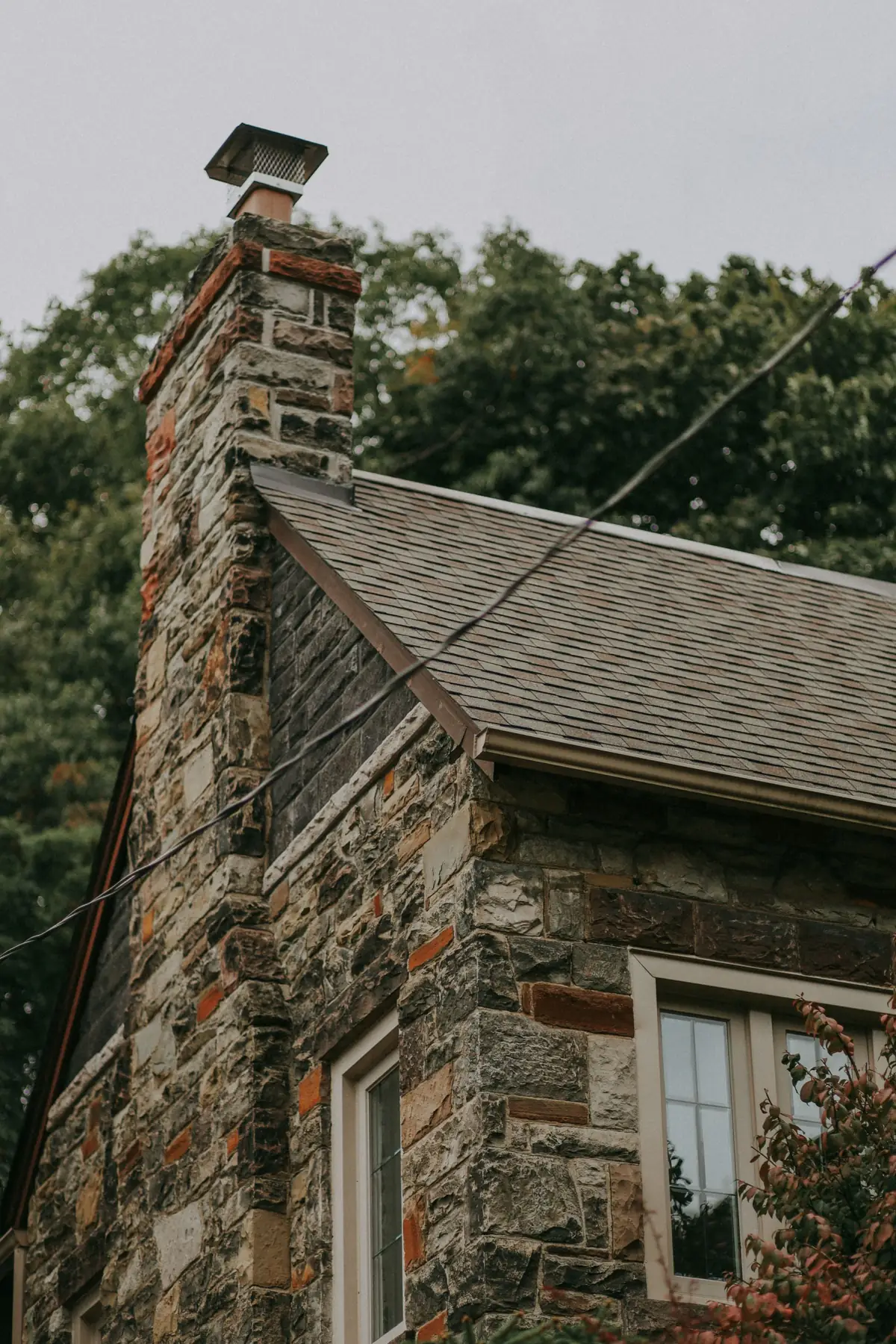
West Chester was built partly from serpentine, the green stone quarried nearby. Westtown Township's newsletter reports that its Serpentine Ridge quarry produced 500,000 cubic yards between 1870 and 1888. The National Park Service's technical note on serpentine says it tends to absorb water, deteriorates with freeze-thaw cycles, is sensitive to acid and is no longer quarried for exterior use. A serpentine chimney or one trimmed in it needs gentle cleaning, a soft mortar, and a top that keeps water out.
The borough's Historical and Architectural Review Board guidelines treat historic chimneys as significant features and say a replacement should be an accurate reproduction of the original. They also give a mortar mix for historic chimney brick, 1 part white Portland cement, 1 part lime and 5 parts sand, and warn that new pointing should not have a high Portland cement content. For a house inside the historic district, we put the photos and scope together with you for the board.
Stone and brick in a hard-freezing county
Older chimneys across the county are brick or local stone. The National Park Service's Preservation Brief 2 explains why the mortar choice matters here more than anywhere: the joint has to stay weaker than the masonry and let it dry out, or freezing water breaks the brick or stone face instead of the joint. We rake out old joints by hand and repoint with a lime-rich mix suited to what is there.
Water gets in at the top first, so the crown and cap come up at almost every Chester County inspection. Current code wants the crown pitched to drain, edged with a drip and kept free of the flue by a flexible seal, plus a cricket on the uphill side of a chimney more than 30 inches wide.
- Repointing the stack in a soft mortar: typically $500 to $2,500.
- Spalled brick or failed stone replaced: typically $1,000 to $3,500.
- New crown with a drip edge: typically $800 to $2,500.
- Breathable water repellent: typically $150 to $820.
Propane, oil and newer houses
Most Chester County homes built since the 1980s have a gas or propane fireplace, or a factory-built firebox with a metal chimney inside a framed chase. Propane appliances need the same yearly attention to pilot, burner, glass and vent as natural gas. A worn igniter typically costs $90 to $150 to replace, and a pilot assembly $100 to $350.
Where oil still heats the house, or where it did until a conversion, the flue matters. The 2021 International Residential Code, in force in Pennsylvania since January 1, 2026, expects the flue to be resized where needed, so condensation stays down, whenever an appliance comes off or goes on. A stainless furnace or boiler liner typically costs $2,100 to $3,800.
Answers
Chester County questions
My house in West Chester has a serpentine chimney. Can it be repointed?
Yes, with care. Serpentine absorbs water and is sensitive to acid, so it needs a soft mortar and no harsh cleaners. If the house is in the borough's historic district, the HARB guidelines ask for a mortar that matches the original and is not high in Portland cement. We help you prepare the photos and scope for review.
Why does my chimney crack more than my friend's in the city?
Freezing. NOAA counts about 131 nights at or below freezing a year at West Chester and 62 in Center City. Every wet freeze widens cracks in the crown and joints, so Chester County chimneys need the top kept tight.
Do you work in Kennett Square, Oxford and Coatesville?
Yes. We work across Chester County, including West Chester, Downingtown, Exton, Malvern, Paoli, Berwyn, Chester Springs, Kennett Square, Coatesville and Oxford.
We heat with propane. Does the fireplace need service?
Yes, once a year is a good habit. A propane fireplace has the same pilot, burner, valve and vent as a natural gas unit, and the same things wear out. The inspection is free, and yearly gas service is priced at that visit.
Does chimney work in Chester County need a permit?
It depends on your township or borough and the job. Pennsylvania's code leaves many plain repairs to local ordinances, and venting or appliance work generally needs a permit. We check what yours requires before any work starts.

Schedule
Choose a morning or an afternoon.
Sunday through Friday, arrival between 8 and 11, 11 and 2, or 2 and 5. The look costs nothing, and a person phones you the day before.