Chimney repair and rowhouse flues in Philadelphia
More than half of Philadelphia's homes share a wall with the house next door. We inspect rowhouse chimneys for free, photograph both sides of the stack and price any work in writing.
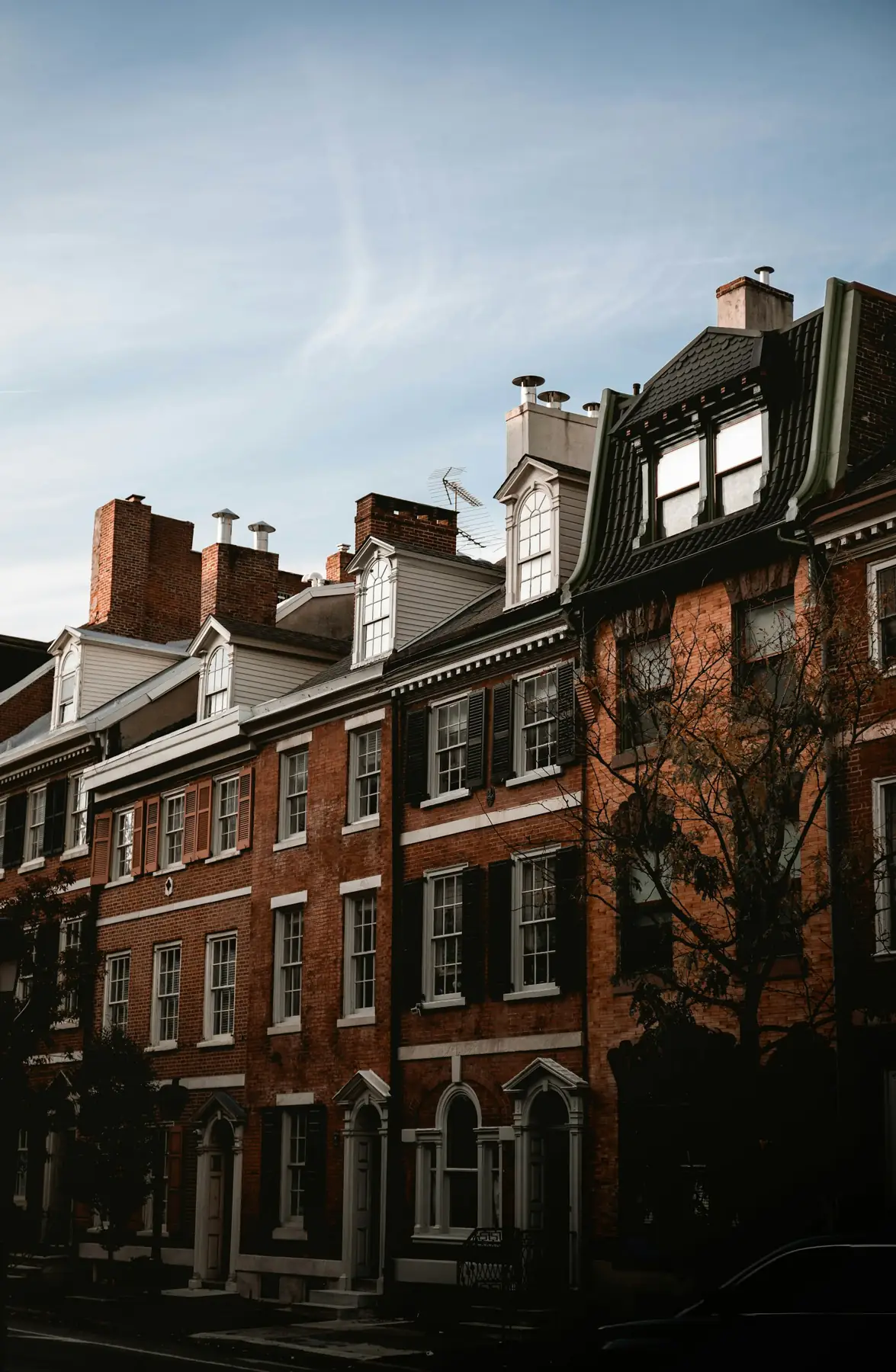
No other big American city is built like this one. The Census Bureau's 2024 survey counts 55.6 percent of Philadelphia's roughly 748,000 homes as one-unit attached houses, meaning rowhouses, twins and townhouses, while the national figure is about 6 percent. Four in ten (39.9 percent) predate 1940, and the median Philadelphia house was built in 1949. The City's own Rowhouse Manual says nearly 45,000 houses went up between 1887 and 1892 alone, most of them rows.
Very few of those chimneys still see a wood fire. Gas heats 69.6 percent of city homes, and the Census counts only about 644 that heat mainly with wood. So the brick stack on a typical rowhouse is really a heater flue: it carries exhaust from a furnace or boiler and a water heater, sometimes beside an old fireplace flue nobody uses. Gas exhaust is wet, and in an unlined or cracked clay flue that water works on the mortar from the inside. During the free visit we check each flue from both ends, roof and basement, take pictures, and price any repair on paper before touching it.
When the house next door goes up a floor
Third-floor additions and roof decks are the most common chimney dispute in the city, and Philadelphia is one of the few places with a written rule for it. Regulation B-3307.1 says that when new construction rises above an adjoining roof and your chimney or vent is within 10 feet, the builder must send you written notice at least 60 days before work starts and offer to secure the permits and fund or perform the extension. The extension needs its own mechanical permit, authorized by you. If you turn the offer down or never answer, responsibility for safe venting shifts to you, and any defect your chimney already had stays yours either way.
L&I's own guidance explains why it matters: building above a chimney obstructs airflow, which brings “increased fire risk, potential carbon monoxide poisoning” and poor appliance operation. Community Legal Services' June 2026 Rowhouse Protection Project report describes a Graduate Hospital homeowner whose neighbor added a third floor; PGW later found elevated carbon monoxide and shut off her gas, and a contractor found her chimney sealed with plywood and tar and no extension ever built. CLS won a $4,600 judgment in May 2026. If you get a notice, call us before you sign anything. We inspect the chimney, document its condition before construction, and price the extension at the inspection. Problems with a builder go to 311.
Party walls, shared stacks and soft city brick
Many rowhouse chimneys sit on or in the party wall, and some stacks carry flues for two houses. No city code says who owns or pays for a shared stack; it depends on which flue serves which house and on your deeds. What we can do is show you, with photos from both roofs where we have access, which flue is yours and what condition each side is in. The Rowhouse Manual adds a warning worth knowing: in older homes, party walls do not always reach the roof.
The brick itself needs care. The manual notes that most Philadelphia brick came from local makers, that its hard outer face protects a much softer interior, and that many 19th-century houses have very thin “butter joints” that must be raked out by hand, not sawn wider. Park Service repointing guidance wants the new joint to be the weaker, more breathable part of the wall, since a harder mix cracks and spalls the brick. In 2026 terms, expect $500 to $2,500 to repoint a stack, $1,000 to $3,500 to deal with spalling brick, and the same $1,000 to $3,500 to rebuild from the roofline up.
- Heater flue liners after a furnace or water heater swap ($2,100–$3,800 for a furnace or boiler stainless liner)
- Crown crack sealing ($150–$550) or a new crown with a drip edge ($800–$2,500)
- Flashing repair where the stack meets a flat rowhouse roof ($300–$1,500)
- Rowhouse chimney extension when a neighbor builds higher: priced at the inspection
Historic districts and the Historical Commission
If your house is designated or sits in a historic district, the Philadelphia Historical Commission's rules treat pointing masonry as an alteration that needs review. Staff can approve pointing and like-for-like repairs, and the Commission's September 2026 permit log shows repointing approved on condition that staff review a mortar sample in the field. L&I says pointing often needs no building permit, but only when the property is not on the historic register. Districts on the City's list include Society Hill, Old City, Rittenhouse-Fitler, Spring Garden, Washington Square West, Parkside, Powelton Village, Girard Estate, Diamond Street, Main Street Manayunk, Tudor East Falls, Overbrook Farms and Germantown Urban Village, among others. The Commission can confirm your status at 215-686-7660.
The Commission's Diamond Street district manual, written for that one district, says metal “B” vents sticking out of chimneys are not approved; it points to terra cotta liners or a metal liner cut below the brick, and it advises against coating chimneys in tar, cement or stucco. Committee minutes from 2020 call old chimneys character-defining and ask that they be repaired rather than removed. We help you prepare the photos, the mortar sample and a written scope for review, and we confirm what the City asks for before anything is scheduled.
Center City, the Northeast and winter weather
The city's heat island shows up in the NOAA 1991–2020 normals. The Franklin Institute station in Center City records about 62 nights a year dropping to 32°F or below; Philadelphia International Airport averages 77 and Northeast Philadelphia Airport 88. A chimney in Mayfair or Somerton goes through noticeably more frost than one in Queen Village, and frost is what pries water-soaked crowns and mortar apart. Rain matters too: Center City averages about 51 inches of precipitation a year. In the January 2016 storm the National Weather Service recorded 22.4 inches of snow at the airport, and drifts like that sit against flashing for days.
Gas safety, PGW and selling your house
PGW tells customers to have appliances, chimney and flue serviced regularly by a qualified technician. Smell gas? Get out first, then ring PGW at 215-235-1212 once you are outside; for symptoms of carbon monoxide poisoning, call 911. The 2021 International Residential Code, in force in Pennsylvania since January 1, 2026, expects a chimney to be resized whenever unplugging an old appliance or hooking up a new one would otherwise leave the flue wet with condensation. That happens when a high-efficiency furnace starts exhausting through the side wall and the water heater ends up alone in a flue far too large for it.
Selling? Under the Philadelphia Fire Code the seller certifies in writing to the buyer that the required smoke and carbon monoxide alarms are installed and working. The City's $139 Property Sales Certification covers zoning and open violations, not chimneys, and no city or state law requires a chimney inspection at sale. The PA REALTORS® disclosure form does ask when the chimneys were last cleaned. Our home-sale findings are free and written so you can hand them to a buyer.
Parts of Philadelphia we cover
Fishtown · Kensington · Port Richmond · South Philly · Point Breeze · Graduate Hospital · Queen Village · Society Hill · Old City · Spring Garden · West Philly · Manayunk · Roxborough · East Falls · Germantown · Mount Airy · Chestnut Hill · Northeast Philly · Mayfair
Answers
Asked in Philadelphia
The builder next door sent me a chimney notice. What happens if I ignore it?
Under Regulation B-3307.1 the builder must give you at least 60 days' written notice and offer to secure permits and fund or perform the extension. If you reject or ignore that offer, you become responsible for keeping your equipment venting safely, and any defect the chimney already had is yours to fix in any case. Have the chimney inspected before the deadline; our inspection is free and the extension is priced at that visit.
My rowhouse shares a chimney with the neighbor. Who pays for repairs?
No Philadelphia code assigns ownership of a shared stack. It depends on which flue serves which house and on what your deeds say. We photograph and document both sides so you and your neighbor are working from the same facts.
Do I need Historical Commission approval to repoint my chimney?
If the house is designated or in a historic district, yes: the Commission treats pointing as an alteration. Staff can approve like-for-like pointing, often after reviewing a mortar sample in the field. We help you prepare the photos, sample and scope.
The furnace we just installed pipes out through a wall. Can the water heater stay on the old chimney safely?
It may not be. Current code says the chimney must be resized when an appliance is disconnected, because a small water heater in a big cold flue makes condensation and weak draft. A furnace or boiler stainless liner typically runs $2,100 to $3,800.
How much is a chimney cleaning in Philadelphia?
Once we have looked at the flue during the free inspection, the price goes on paper before any brush comes out.

Schedule
Philadelphia visits, no charge to look.
Sunday through Friday, arrival between 8 and 11, 11 and 2, or 2 and 5. The look costs nothing, and a person phones you the day before.